

Behind the Chart | on 'Ghost Ships in Literature'
BTC01 || Every research leaves a bit of wreckage behind.

Behind the Chart is where the research goes when the essay can’t hold it.
Each piece accompanies a published Fathoms Deep essay and follows threads the argument had to drop — disputed sources, extended readings, and all the questions that stayed open.
You’ve already read the essay (I hope). This is what was left on the chart table.
Every research leaves a bit of wreckage behind.
It can be the pile of books still on your desk. The papers strewn about that you haven’t quite decided what to do with. The cups of coffee that congealed while you were reading. The cigarette stubs. The two hundred tabs still open on your desktop, each one a thread you followed somewhere and didn’t fully close.
Research drifts. New ideas need space — real space, the kind that comes from emptiness. It’s hard to build something new and interesting on top of the remnants of the last thing, the sources that didn’t make the cut, the ideas that almost fit but didn’t quite. So when you’re ready to start something new, you close the door on what you’ve accumulated. At least, that’s what I’ve always done — wiped the slate clean and moved forward.
Recently, I’ve wanted to keep some of it. Save the interesting parts before they disappear.
Not everyone will want this. This kind of content is more personal and less educational than the essays, and I know that. It won’t be consistent — probably once a month, when there’s something worth saving. And it will be paid, because I’d rather it find the people who are genuinely interested than be stumbled upon by accident.
So. Here’s what’s left from the ghost ships research.
I’ve always avoided defining myself as a horror fan or a horror writer. And it’s interesting, because while writing this essay a memory resurfaced — me pleading and bribing an adult to be let into the movie Ghost Ship. I was very young, too young for it. I remember loving it, and I remember not quite knowing why.
The thing is, I had grown up reading Dylan Dog, the nightmare investigator, from the age of ten. That’s how I learned to read comics. So in a sense I’d been reading horror for years — I just didn’t recognise it as such, because what I was reading was psychological, atmospheric, built on dread rather than shock. And Ghost Ship was the same thing. A specific kind of wrong. A location that seemed to attract its own victims, trap them, repeat itself. That kind of story I understood instinctively.
What I didn’t understand, or didn’t want to claim, was the other kind. The kind that was everywhere in my age group: splatter, gratuitous violence, the long lineage of films where a monster follows a sweet feeble heroine through a swamp and kills her. Which, forgive me, is nothing but the fantasy of a frustrated male ego — someone who feels unacceptable getting the girl anyway, through force.
(Thank you Whedon for making the blonde a badass.)
And it’s interesting to see how that’s evolved. The heroine now goes into the swamp looking for the monster herself, because clearly the monster was never the problem.
The horror was never the guy. The horror was the powerlessness, the absence of consent, the trap. That, I never found interesting. Jump scares didn’t interest me. Gore didn’t interest me. I prefer dread. The slow and unavoidable escalation of something wrong. But it has to mean something.
So I never described myself as a horror reader, and certainly never thought of myself as an horror writer. And then the comic happened — a ghost ship story, a Portuguese pilot in the mid-1500s, a crew of the living dead — and somewhere in the process of actually writing the script I realised I had pitched a horror story without knowing it. The editors noticed too. And I thought: maybe I’ve been writing horror all along and calling it something else.
Which is, I suppose, its own kind of unfinished business.

All of that brought me back to the research, and specifically to the references I’d chosen for the essay. Coleridge was always a shoo-in — the albatross is still the definitive image of senseless guilt, of being stuck with something you did for no reason you can name. And I also wanted to include Poe — specifically MS. Found in a Bottle, one of his earliest published stories and not the one anyone reaches for first. It’s so rare that I get to cite something of his that isn’t completely mainstream, I could not pass it up. For those who love him, I think it was a treat.
But the most interesting thing happened when I went back to Dracula.
Dracula was the first grown-up book I ever bought. I was about ten or twelve — I have two sharp, vivid memories of buying books around that age. One was a fantasy, and the other was Dracula (guess there is no sense in telling you what I write now). And I devoured it.
I don’t know how I managed to read it without seeing certain things in it. I was probably just blind to them, the way you are at twelve.
Which means the whole set of issues people seem to have regarding the role of women in Dracula went completely over my head. I discovered the feminist criticism of it much later. By then I had already read it and assimilated it in my own way, and I wasn’t going to reread it just to change my mind on it.
So, I picked it back for the essay on ghost ships, and I went to look for the relevant passage.
In the novel, a Russian ship arrives in Whitby during a storm. Because Dracula is structured entirely as found documents — letters and journals and newspaper clippings assembled after the fact — we know about this from the ship’s log, written in the captain’s own hand. He describes how his crew started disappearing, one by one. The entries grow stranger as the numbers thin. In the end, he is alone, and he says he knows what is in the hold (but doesn’t tell us), and he lashes himself to the wheel. His final entry says he will tie to himself something that Dracula cannot touch, and so he will save his soul and his honour as a captain.
I remember reading that the first time and thinking: why didn’t he burn the ship down? Why didn’t he blow it up, steer it somewhere else — it’s not like Dracula was an expert navigator. But the fact is, this captain believes there is no way out. He makes no attempt to save his crew, himself or the people of England who will receive what he’s carrying. No gesture toward the shore. None.
What he does is save his own soul. His honor. It’s worth noting that the English word ghost originally meant soul — Holy Ghost, the soul that remains. So he is sealing his own ghost, his own soul, and going down with his ship. That is what matters to him. That is who he is.
And then I remembered something else.
Lucy Westenra goes to the cliff while sleepwalking, way before that ship docks. Way before anyone has an idea of what’s coming (or that anything is coming at all!). And the thought I had — reading the captain, then going back to that scene — was: what if this is not suggestibility. What if it is intuition.
There is an existing feminist reading of Dracula, and it’s not very flattering for the women. It presents them as weak, irrational, in need of protection from their own desires. Stoker positioned Mina as secondary to her husband. Lucy is seduced to her death. The standard critique says: this book tells us women are weak, and this is bad, and we should note that it’s bad.
But I kept thinking about what the text actually shows.
It is Mina who collates everything — the letters, the phonograph recordings, the ship’s log, the newspaper archives — and lays the complete picture in front of the men. Until then, they are running around like headless chickens, regardless of how much expertise they have.
Even Van Helsing, with all his experience, looks at Mina’s work and says: this is very interesting, why haven’t we thought of this before. The men in Dracula react with fear when the threat finally becomes undeniable. The women were already there — already sensing it, already drawn to it, already trying to understand it.
However you want to interpret the vampire — as the foreign, the sexual, the dangerous other, the new — the women are the ones who perceive it first. Lucy goes to the cliff. Mina keeps the record.
Meanwhile Jonathan Harker stays in Castle Dracula for weeks, notices everything, writes it down and then has a mental breakdown and comes home with nothing.

And I thought: maybe when I was young, I wasn’t that dumb. Maybe I kept this book as one of my favourites because it doesn’t actually present women in a bad light. It’s the lens through which people decided to read it that does.
If you say — well, of course, at that time women were second-class citizens, of course Stoker is writing against them — you are projecting that age’s prejudice onto his writing. But what if that reading is wrong? What if Stoker was writing smart women, intuitive women, and somewhere along the way we decided he must have meant the opposite because of when he was born?
I’m not saying I’m right. Unless Stoker comes back himself (wink), we cannot ask him what he meant. But new readings give us new perspectives on old work. And considering I’m not entirely sure about the meaning of my own work sometimes — how can we be certain about someone else’s? One hundred percent? We can’t.
So I’ve started writing an essay on exactly this (it will be coming out in August, probably). If there are any Dracula lovers or haters among my readers, I invite you to read it when it comes out and tell me what you think.
In the meantime, I find myself making a list. Which other books from that era would be interesting to reread this way? Are they really pushing women as weak, or is it us reading weakness into them because that’s what we expect to find?
I think this kind of reflection — noticing which themes you keep returning to, which questions your subconscious is still chewing on — is one of the more interesting things a writer can do. You don’t always choose your obsessions consciously (or never). Sometimes you just notice, looking back, that you’ve been circling the same water for years.
That’s all for this first edition of Behind the Chart. From now on, this kind of content will be for paid subscribers — it’s personal, it’s not purely research, it’s me following the threads the essays leave behind. If you like it, subscribe. And I’ll see you in the next one.
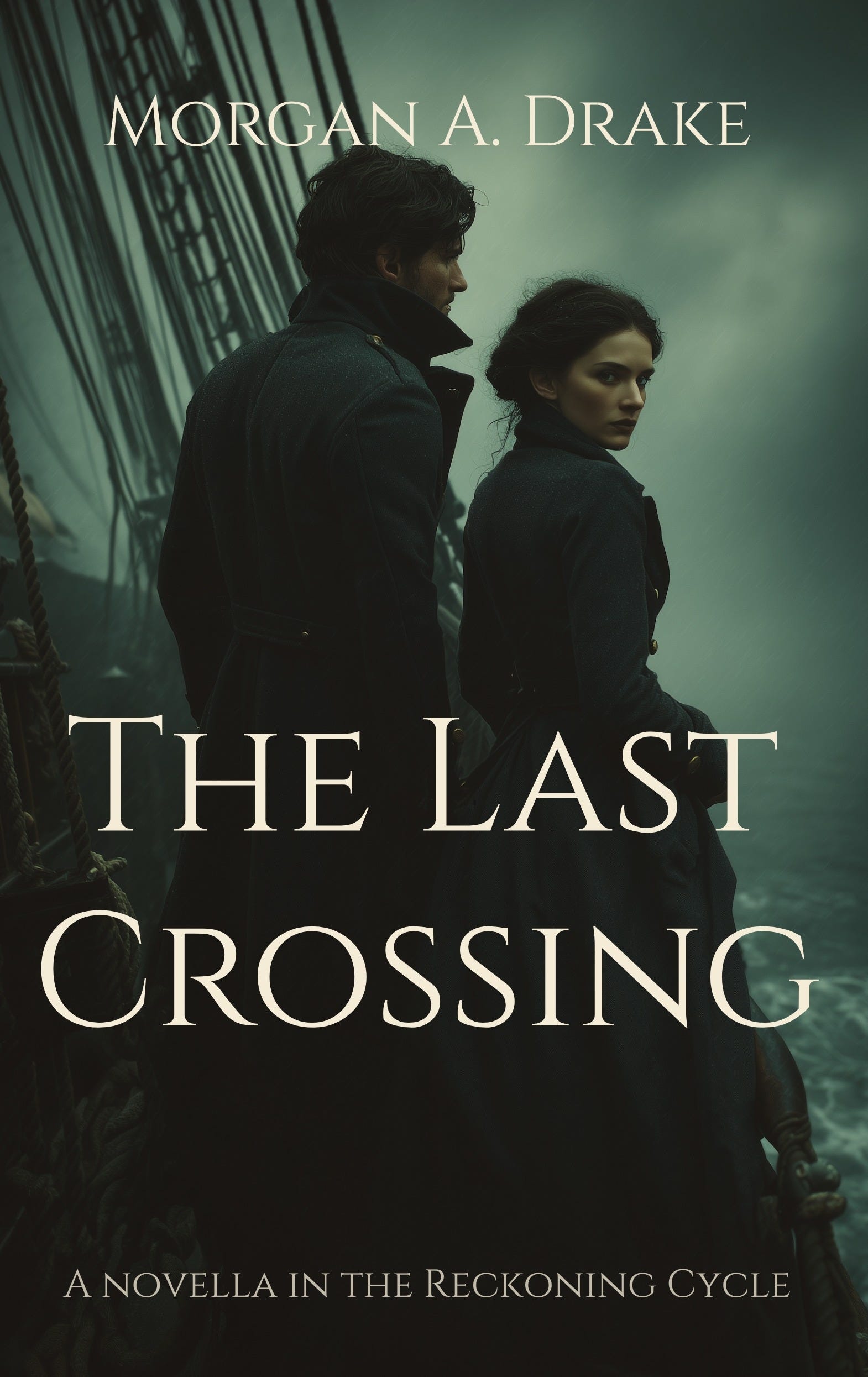
To see what my version of the ghost ship ended up being, you can get the Dead Reckoning graphic novel as part of the ‘Parallel Truths’ Anthology on Kickstarter, or download its prequel novella The last Crossing for free
(or start reading it here).
You Might also Like:


About the Author:
Morgan A. Drake crafts gothic paranormal fiction and dark maritime fantasy that explores the boundaries between historical seafaring traditions and the supernatural. Drawing on years of research into maritime mysteries and folklore, Morgan creates worlds where the line between natural and otherworldly perils blurs with the horizon.
Read Morgan's Fiction at:


A note on the Images: Unless credited, illustrations accompanying the posts are creative interpretations designed to evoke the atmosphere of maritime legend rather than serve as historical documentation. For historical visual references, please consult the sources listed in the references section.