

Behind the Chart | on the making of 'Atlantis'
BTC02 || Why silence the gods? Why hold judgement, when we already know how the punishment was meted out?

Behind the Chart is where the research goes when the essay can’t hold it.
Each piece accompanies a published Fathoms Deep essay and follows threads the argument had to drop — disputed sources, extended readings and the questions that stayed open. You’ve already read the essay. This is what was left on the chart table.

A short note about the introduction of Pangram on the platform, and my pieces.
Fathoms Deep publishes complex pieces for an insightful and curious readership.
After exploring how the Pangram model was built I realised pieces like mine, written by a non-native speaker, in a more academic and essayistic style, pieces that contain extensive bibliographies, references etc. will be showing up ‘patterns’ recognised by Pangram AI model as ‘repetitive’ and ‘formal’, hence dubbed by it as ‘AI’ even without being such.
Realising how unavoidable this was (and after having a bit of a frustrated fuck this whole thing! moment about it), I have chosen not to disable the feature for you, my readers, as I confide in your power of discernment.
It is of course your prerogative to use the machine, believe the machine, and obey the machine.
I really appreciate all of you here
Behind the Chart
on the making of ‘Atlantis, the City that Keeps Forgetting’
To be completely honest, there was already an Atlantis essay in my drafts. Different argument, different thesis — or rather, a thesis that tried to be several theses at once, which is the same thing as having no thesis. When I went back to read it before scheduling it, I knew almost immediately it wasn’t going to work. Too wide. Too vague. It answered nothing with any real force because it was trying to answer everything.
So I started again from the one question that felt genuinely live to me: why does the Critias stop where it stops? Not at the end of a section. Not at a natural pause. But precisely at the moment Zeus begins to speak.
Why silence him? Why silence the gods? Why hold judgement, when we already know how the punishment was meted out?
What if it means Atlantis’ —our— judgement is still ongoing? And why nobody else has asked this question before?
I stress-test arguments. It’s not a method exactly, more a habit — I look for the thing that would break what I’m trying to say, and I follow that until either the argument holds or it doesn’t. The first thing that looked like it might break the cycle theory I have was what I’ve been calling the Nesselrath problem, after the classicist Heinz-Günther Nesselrath whose work on Plato’s Atlantis dialogues is about as rigorous as this territory gets.
The problem was simple: if proto-Athens and Atlantis are the same city at different points in a moral cycle, you’d expect proto-Athens to eventually decay the way Atlantis did. But it doesn’t. It gets destroyed by flood — the same flood that takes Atlantis — before any such decay can occur.
If we interpret the flood as punishment and nothing else, proto-Athens’s destruction makes no sense. A cycle driven by internal corruption can’t account for what happens to the virtuous city — not on its own. Something else has to be going on. The flood is external. It doesn’t care about moral status.
That sent me into flood mythology, which was a rabbit hole I was not expecting to enjoy as much as I did. Because here is the thing, almost every major civilisation has a flood myth, and their deeper meaning are almost never about water itself.
The Mesopotamian flood, the Deucalion myth, the Ogyges tradition in Greece, the Manu story in the Vedas, the Utnapishtim episode in Gilgamesh — these are structurally the same story, and the structure is not “terrible natural disaster” but “the world returning to a state before memory.” Before record. Before the accumulated weight of what happened previously. The flood is the reset. It is how the slate is wiped clean for the next generation to begin, innocent of what came before.
When I realised that, the problem dissolved — or rather, it turned into something more interesting. The flood was clearly not doing to Athens what it did to Atlantis. Atlantis gets pulled under as punishment, the external confirmation of an internal collapse. Proto-Athens gets pulled under as something closer to preservation: the only way a mortal city stays perfect is if it stops. It never decays because it never continues. But a city that has stopped cannot teach anyone anything. The knowledge goes down with it. What comes back up, eventually, is the name.
I’m fairly sure that flood mythology lineage will be another essay. Probably a Myths & Legends piece — it’s too large and too interesting to leave as a footnote here.

Most of the serious scholarly work on the Atlantis dialogues is written by philosophers and classicists, and they approach Plato the way you’d expect: looking for the argument, the logical position, the philosophical claim. Which is the right approach for most of what he wrote. But it means they tend to read through the form of the text to reach its content — and in doing so, they miss what the form itself is doing.
This is, I will note, extremely ironic given the essay’s subject matter.
As someone who writes fiction, I’ve spent a lot of time thinking about how the container of a story is never neutral. The choice of narrator is an argument. The choice of what to leave incomplete is an argument. Even the choice of who speaks and who doesn’t is an argument. When Plato decides that the speaker of the missing third dialogue — the Hermocrates, the final act of the trilogy — will be Hermocrates of Syracuse, that decision has weight.
Hermocrates isn’t a household name, so let me give him a moment. In 415 BCE, Athens launched what is probably the most catastrophically overconfident military expedition in its history: the Sicilian Expedition, an attempt to extend Athenian imperial power to Syracuse, on the western edge of the Greek world.
The justifications were various. Not entirely dishonest, either — allied obligations, strategic arguments, the usual mix. But Thucydides, who documented the expedition in the History of the Peloponnesian War, isn’t buying it, not fully. The Athenians were driven partly by the desire for Sicily’s wealth. And partly by what he describes as eros — a passionate longing, almost irrational in its intensity, for more (the Platonian appetite).
Athens had convinced itself that the expansion was strategic. What it wanted was also, somehow, what it deserved.
The expedition ended in 413 BCE with the near-total destruction of the Athenian force. Of the thousands who sailed, almost none returned.
Hermocrates was the Syracusan general who won that battle. He defeated Athens at the precise moment when Athens was being most thoroughly Atlantean — A maritime empire, divine overconfidence and an appetite dressed in entitlement. And Plato, writing roughly forty years after the disaster, chose this man to deliver the divine verdict — the judgment Zeus was about to pronounce when the Critias broke off — in the dialogue that was never written.
This man, who had brought Athens (Plato’s Athens) to its knees, would be the one to deliver the gods judgement on Atlantis in the third book. This is clearly a mirror of Critias the Tyrant extolling the virtues of Athens.
Now tell me structure doesn’t matter.
There was another small thing when it came to Critias relationship with Plato, which took me longer to resolve than it should have.
Scholarly shorthand calls him Plato’s uncle, and I used that framing instinctively for a long time before checking. He’s more precisely Plato’s mother’s cousin — close enough that Plato certainly knew him personally and watched the whole arc of his life, but the simplification from cousin to uncle is itself a small example of what the essay itself is about.
Names do this. They shed precision over time and keep the affective weight — the intimacy, the family connection — without the actual texture of what the relationship was.
What matters for the essay isn’t the exact degree of kinship of course, but the physical and emotional proximity — Plato watched this close relative accumulate and then abuse power, watched him push the Thirty Tyrants toward violence, watched him die in the democratic restoration of 403 BCE. And then, some thirty-odd years later, gave this very man the role of remembering Athens’s finest hour in a story about what happens when names outlast their meaning.
Whether Plato did this consciously I can’t say. I think he did. But I’ll say this: if Critias is the best Athens could produce for carrying this particular memory — the most distinguished person available for the role of custodian of Athenian virtue and remembrance — then what does that say about everyone else?
What judgement is Plato passing on the entire political system, and on Athenians as a whole, if Critias is the best of them?

Finally, Plato’s cave.
Plato’s cave is one of those images that has been summarised so many times it’s become a shadow of itself — which is either ironic or appropriate, depending on how you look at it. You probably know the outline of it: prisoners chained underground, watching shadows on a wall, mistaking the shadows for reality.
The philosopher is the one who turns around, climbs out, sees the sun, and comes back to tell them the truth. He is, of course, doubted.
There’s a common reading of this that has been circulating for years and that flattens the cave’s meaning into one of: “question authority” or “don’t trust institutions.” And that’s not wrong, exactly, but it’s also not the whole point.
The prisoners in the cave aren’t ignorant — they’re surrounded by information. They have access to everything the cave makes available. The problem isn’t lack of data. It’s epistemology. The shadows are moving, the prisoners are observing and describing them, they have a whole shared vocabulary for what they see. Thus they believe they know the shadows, and all there is to know about them.
What they don’t have is the willingness — or the curiosity — of turning around and asking ‘Where does it come from?’ and ‘Why?’ and ‘How?’ and ‘Is there more?’.
Plato’s concern isn’t that people know too little of their world. It’s that they mistake access to representations for understanding of the things themselves.
Socrates as his mouthpiece, throughout the dialogues, refuses to simply give out conclusions. He makes people arrive to understanding. And he makes the journey difficult on purpose, because the moments of friction are where the understanding happens. A conclusion handed over without the work that produced it is nothing but an empty shadow. An empty name.
And here it all loops back to Atlantis. People are legitimately still looking for an actual island island, and not because they’re credulous, nor because they haven’t read the scholarship, but because they were given the name without the curiosity that generated it. They saw the shadow and they’re looking for an explanation on the wall itself.
Or they are just talking about the shadow, and not looking for an explanation at all.
That’s the cave. That’s the trap.
That’s also the essay’s ultimate question — not whether we can find Atlantis itself (whether as submerged ruins, or as a societal ideal), but whether we still have or not the desire to understand it, pursue its meaning and see it for what it actually was.
© 2026 E.M.V writing as Morgan A. Drake. All rights reserved.If any of these threads interests you — the flood mythology lineage across civilisations, or the Hermocrates question and what it suggests about what Plato was actually doing with the trilogy’s structure — leave a comment.
A note on this piece being free:
Behind the Chart normally lives behind the Fathoms Deep paywall — it’s where the research goes that doesn’t fit the essay, and it’s one of the things paid subscribers get access to alongside early reads, extended bibliography, and commentary on the research and editorial choices behind each piece.
I’m making this one free because I want you to know what it is before I ask you to pay for it. If you’ve read the Atlantis essay and this felt like the continuation of a conversation you wanted to have — that’s what the paid tier is for.
If that’s of interest, the subscribe button is below. If not, the free essays aren’t going anywhere.
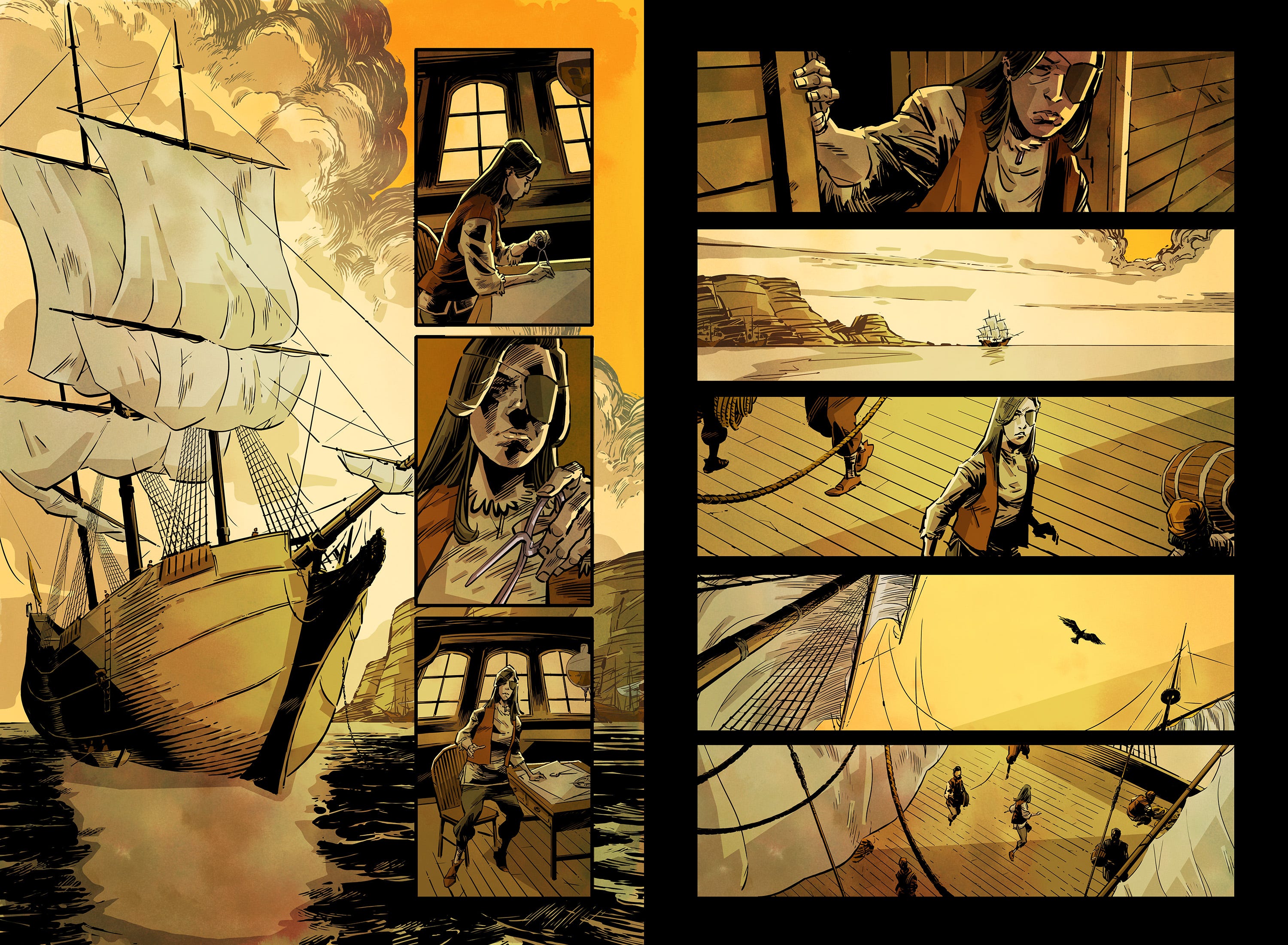
If you like your mysteries in a different format, you can get the Dead Reckoning graphic novel as part of the ‘Parallel Truths’ Anthology on Kickstarter (late pledges are still open!!!)
or download its prequel novella The last Crossing for free.
References and Further Reading For ‘Atlantis, the City that Keeps Forgetting’
Primary Sources
Plato. Timaeus and Critias. Translated by Desmond Lee. Penguin Classics, 1971. — The most accessible single-volume translation for general readers; Lee’s introduction remains useful on the dialogue’s structure.
Plato. Timaeus. Translated by Donald J. Zeyl. In Plato: Complete Works, edited by John M. Cooper. Hackett Publishing, 1997.
Plato. Critias. Translated by Diskin Clay. In Plato: Complete Works, edited by John M. Cooper. Hackett Publishing, 1997. — Clay’s notes on the incompleteness of the Critias are particularly relevant to the argument made here.
Plato. Republic. Translated by G.M.A. Grube, revised by C.D.C. Reeve. In Plato: Complete Works, edited by John M. Cooper. Hackett Publishing, 1997. — Books VIII and IX, on the constitutional cycle of decline, are essential context for the Atlantis dialogues.
Xenophon. Hellenica. Translated by Carleton L. Brownson. Loeb Classical Library, Harvard University Press, 1918–1921. — Books II.3–II.4 contain the primary account of Critias and the Thirty Tyrants; the speech of Critias in the Senate is in Book II.3.
Classical Commentary
Proclus. Commentary on Plato’s Timaeus. Translated by Harold Tarrant et al. Cambridge University Press, 2007. — Proclus surveys ancient debates about whether Atlantis was historical or invented; useful for tracing the reception question from antiquity.
Aristotle. On the Heavens. Translated by W.K.C. Guthrie. Loeb Classical Library, Harvard University Press, 1939. — The famous line attributed to Aristotle — that the man who invented Atlantis also destroyed it — survives through later testimony rather than in Aristotle’s own surviving text; the attribution is debated.
Scholarly Analysis
Vidal-Naquet, Pierre. “Atlantis and the Nations.” Critical Inquiry 18, no. 2 (1992): 300–326. — The foundational modern scholarly argument for Atlantis as political allegory; the reading in this essay extends and departs from his conclusions.
Gill, Christopher. “Plato’s Atlantis Story and the Birth of Fiction.” Philosophy and Literature 3, no. 1 (1979): 64–78. — Argues for reading the Atlantis dialogues as conscious fiction-making; includes the identification of Critias the speaker with Critias the Tyrant.
Nesselrath, Heinz-Günther. Platon und die Erfindung von Atlantis. K.G. Saur, 2002. — The most rigorous philological examination of Plato’s invention; in German, but essential for anyone pursuing the question of the Hermocrates and the trilogy’s structure.
Broadie, Sarah. “Nature and Craft in Plato’s Timaeus.” In Plato’s Timaeus as Cultural Icon, edited by Gretchen J. Reydams-Schils. University of Notre Dame Press, 2003. — On Plato’s constructive method in the dialogues.
Nails, Debra. The People of Plato: A Prosopography of Plato and Other Socratics. Hackett Publishing, 2002. — Authoritative reference for the historical identities of characters in the dialogues, including Critias.
On the Constitutional Cycle and Political Theory
Plato. Laws. Translated by Trevor J. Saunders. Penguin Classics, 1970. — Plato’s late political philosophy, which revises and complicates the Republic‘s constitutional sequence; useful background for the Atlantis argument.
Polybius. The Histories, Book VI. Translated by Robin Waterfield. Oxford University Press, 2010. — Contains the most fully developed ancient account of anacyclosis (the cycle of constitutional forms); Polybius builds explicitly on Plato and Aristotle.
On the Thirty Tyrants and Historical Context
Krentz, Peter. The Thirty at Athens. Cornell University Press, 1982. — The standard historical account of the junta; essential for understanding Critias’s role and the political context of Plato’s early life.
Wolpert, Andrew. Remembering Defeat: Civil War and Civic Memory in Ancient Athens. Johns Hopkins University Press, 2002. — On how Athens processed and remembered the trauma of the Thirty; relevant to the essay’s argument about institutional memory and forgetting.
On Memory, Forgetting, and Civilisational Transmission
Assmann, Jan. Cultural Memory and Early Civilization: Writing, Remembrance, and Political Imagination. Cambridge University Press, 2011. — The most rigorous theoretical account of how civilisations construct and transmit collective memory; directly relevant to the Egyptian priests’ diagnosis in the Timaeus.
Assmann, Aleida. Cultural Memory and Western Civilization: Functions, Media, Archives. Cambridge University Press, 2011. — A useful complement to Jan Assmann, with particular attention to the archives and institutions through which memory is transmitted or lost.
Nunn, Patrick D. The Edge of Memory: Ancient Stories, Oral Tradition and the Post-Glacial World. Bloomsbury Sigma, 2018. — On how oral traditions preserve and distort memory of catastrophic events across generations.
Ong, Walter J. Orality and Literacy: The Technologizing of the Word. Methuen, 1982. — Essential background for the essay’s argument about institutional memory and the difference between oral and written transmission; Ong’s analysis of what writing preserves and what oral culture cannot hold is directly relevant to the Egyptian priests’ diagnosis in the Timaeus.
Related Reading on the Fathoms Deep Archive


About the Author:
Morgan A. Drake crafts gothic paranormal fiction and dark maritime fantasy that explores the boundaries between historical seafaring traditions and the supernatural. Drawing on years of research into maritime mysteries and folklore, Morgan creates worlds where the line between natural and otherworldly perils blurs with the horizon.
Also from Morgan


A note on the Images: Unless credited, illustrations accompanying the posts are creative interpretations designed to evoke the atmosphere of maritime legend rather than serve as historical documentation. For historical visual references, please consult the sources listed in the references section.
© 2026 E.M.V writing as Morgan A. Drake. All rights reserved.