

The Bermuda Triangle
Between the limitations of certainty and the necessity of wonder.


Listen to the Audio Narration of this episode on our podcast, linked above, or read the full Essay below.The Bermuda Triangle, Charting Uncertain Waters
The compass needle swings wildly, its familiar certainty suddenly abandoned. Radio communications dissolve into static or fall eerily silent. Electronic navigation systems display impossible coordinates or simply go dark.
Above, the sky shifts from Caribbean blue to an unnatural haze that seems to distort distance itself.
Somewhere in that haze, aircraft vanish in mid-flight, ships sail beyond the horizon and into oblivion, and crews disappear without distress signals—all within a region where maps meet mystery.
"The triangle is a mystery, without question... But it's a mystery that, examined logically, is really not much of a mystery at all." — Howard Rosenberg, Los Angeles Times, 1976
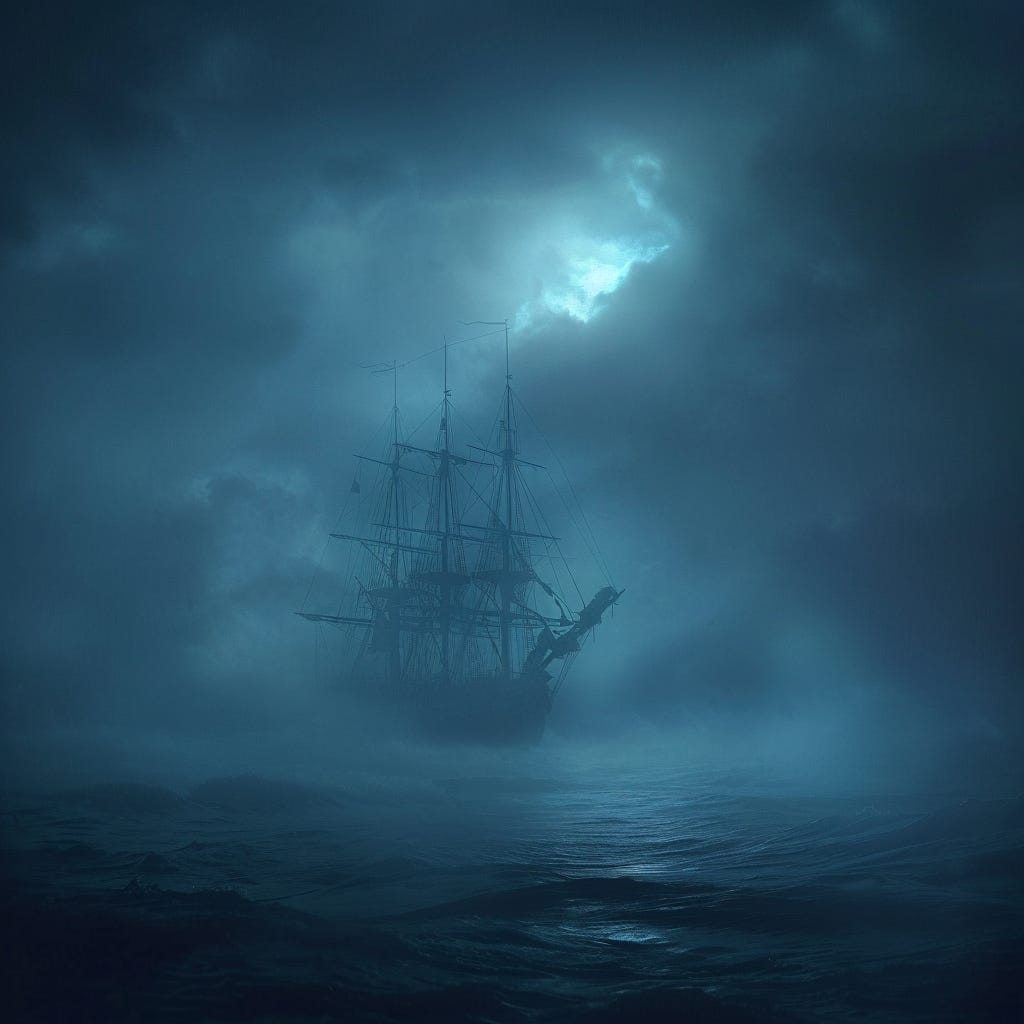
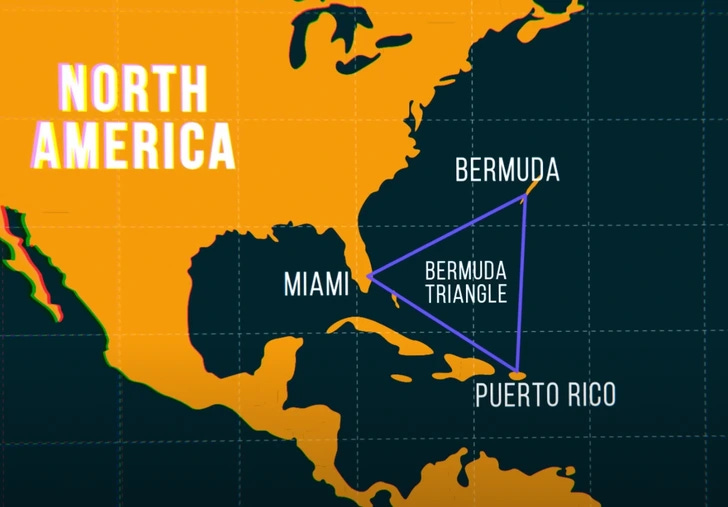
For over a century, stories of inexplicable disappearances have clustered around the roughly triangular region spanning from Florida to Bermuda to Puerto Rico.
This watery realm—known as the Bermuda Triangle, the Devil's Triangle, or the Hurricane Alley—has consumed hundreds of vessels and aircraft according to popular accounts, shifting from navigational hazard to supernatural enigma in our collective imagination.
But where does history end and mythology begins? And why does this particular patch of ocean maintain such powerful grip on our fears despite the rational explanations science offers?
THE CARTOGRAPHY OF FEAR: MAPPING THE UNMAPPABLE
The Bermuda Triangle exists today in that curious territory between geographical fact and psychological construct.
No official body recognizes its boundaries on navigational charts; no special warnings mark its presence on maritime maps.
Its precise corners and borders shift depending on who tells the tale—some accounts place the triangle's area at 500,000 square miles, others at over a million.
The triangle received its name from science writer Vincent Gaddis in a 1964 Argosy magazine article titled "The Deadly Bermuda Triangle," though reports of unusual occurrences in the region predate this formal christening.
Gaddis described the area as "a watery wilderness scene of the mysterious disappearance of countless ships and planes" and connected previous incidents into a pattern suggesting that "something" about this particular region held unusual dangers for those traversing it.
This fluidity of definition itself represents the first clue to understanding the Triangle's enduring power: it resists precise cartography.
It exists as a region of possibility rather than definitive coordinates—a psychological space as much as a geographical one.
Maritime historian Daniel G. Parrott observes in his work Tall Ships Down that humans have long designated certain waters as particularly dangerous:
"Throughout maritime history, certain regions have acquired reputations as especially hazardous to navigation—whether from natural features, weather patterns, or navigational challenges. What makes the Bermuda Triangle unique is not its dangers, but the supernatural qualities attributed to otherwise explicable maritime hazards."
— Daniel G. Parrott, Tall Ships Down, 2003
What makes the Bermuda Triangle distinctive is its emergence in an age when we presumed the oceans fully mapped and understood.
Unlike earlier maritime mysteries situated beyond the edges of known territory, the Triangle manifested within heavily trafficked waters of the modern world—a geographical anomaly that shouldn't exist in an era of radar, sonar, and satellite surveillance.
THE VANISHINGS: CASES THAT DEFINED THE LEGEND
The Bermuda Triangle's mythology rests upon a foundation of documented disappearances, though precisely which incidents "belong" to the Triangle phenomenon remains contested.
Several cases, however, stand as the canonical events that transformed this regional sailing hazard into a supernatural enigma.
USS Cyclops: The Vanishing Leviathan
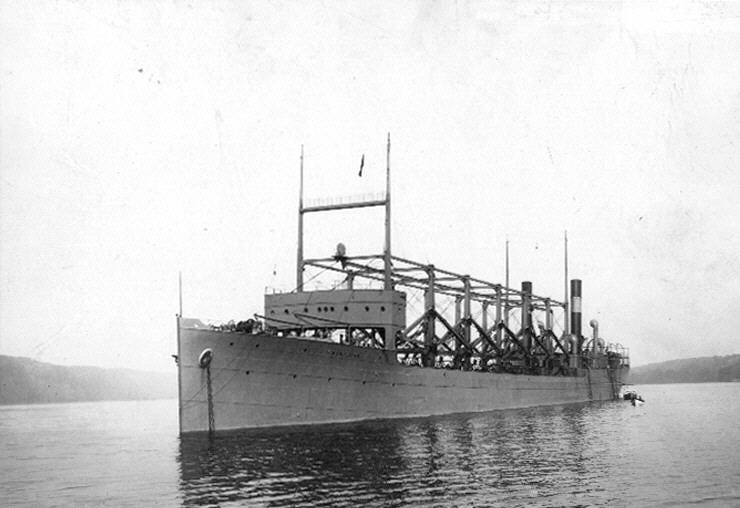
Perhaps the most dramatic single loss attributed to the Triangle occurred in March 1918, when the USS Cyclops—a massive 542-foot naval collier displacing 19,000 tons—disappeared without trace while traveling from Barbados to Baltimore.
The vessel carried 306 crew and passengers, making it the single largest non-combat loss of life in U.S. Naval history.
The Cyclops sent no distress signal, left no debris field, and disappeared in good weather.
Naval historians note the vessel was carrying a heavy load of manganese ore, was known to have structural issues, and one of its engines was inoperative—all potential contributors to a catastrophic failure.
Yet the total absence of wreckage or survivors continues to trouble conventional explanations.
After extensive unsuccessful searches, the U.S. Navy issued an official statement:
"The disappearance of USS Cyclops has been one of the most baffling mysteries in the annals of the Navy, all attempts to locate her having been unsuccessful. There were no enemy submarines in the western Atlantic at that time, and there were no signs of any sort of explosion or violence."
— U.S. Navy Historical Center
What makes the Cyclops case particularly compelling is that two of her sister ships—the USS Proteus and USS Nereus—vanished in the same region during World War II, both without distress calls, both without leaving traces.
The incident that cemented the Triangle in public consciousness though, occurred on December 5, 1945, when five U.S. Navy TBM Avenger torpedo bombers on a routine training exercise disappeared off the coast of Florida.
The flight, led by Lieutenant Charles Taylor, consisted of experienced pilots (though accounts differ regarding Taylor's familiarity with the area).
Radio transmissions captured their disorientation.
According to the official Navy report and transcripts, Taylor reported:
"We don't know where we are. We think we must be about 225 miles northeast of base... We cannot see land... We seem to be off course... We cannot be sure of any direction... Even the ocean doesn't look as it should."
The final transmissions, picked up at approximately 7:04 PM, contained only fragments suggesting the planes were still airborne but thoroughly lost.
A Martin Mariner flying boat dispatched for search and rescue subsequently disappeared as well, adding another layer to the mystery.
While official explanations cite human error, disorientation, and fuel exhaustion as the likely causes, the complete absence of debris despite an immediate and extensive search remains difficult to explain.
The incident's proximity to other Triangle disappearances transformed it from an isolated accident to the cornerstone of an emerging pattern.
SS Marine Sulphur Queen: Modern Vanishing
More recent disappearances maintain the Triangle's reputation into the modern era.
On February 4, 1963, the SS Marine Sulphur Queen, a converted T2 tanker carrying molten sulfur, disappeared without distress signal between Beaumont, Texas and Norfolk, Virginia. The vessel carried 39 crew members.
Despite an extensive search, only minimal debris was recovered—a life jacket, life ring, and a few planks.
The Coast Guard investigation suggested several potential causes, including possible ignition of sulfur fumes or structural failure.
Critics of supernatural explanations note the vessel had been cited for numerous deficiencies and may have been unseaworthy.
The official Marine Board of Investigation concluded:
"The Board determines that the SS Marine Sulphur Queen, as a result of an unknown casualty, foundered and sank in the straits of Florida on or about 4 February 1963. The Board is unable to determine from the evidence the exact cause of this casualty."
— United States Coast Guard, Marine Casualty Report, 1963
Yet the case fits the pattern that defines Bermuda Triangle incidents: a modern vessel with experienced crew, no distress call, minimal wreckage, and an absence of human remains.
THE RATIONAL DEPTHS: POSSIBLE SCIENTIFIC EXPLANATIONS
Behind the Triangle's supernatural reputation lie several natural phenomena that could explain at least some of the region's unusual characteristics and reported disappearances.
Meteorological Factors: The Perfect Storm Factory
The Triangle's location places it in one of the world's most meteorologically volatile regions.
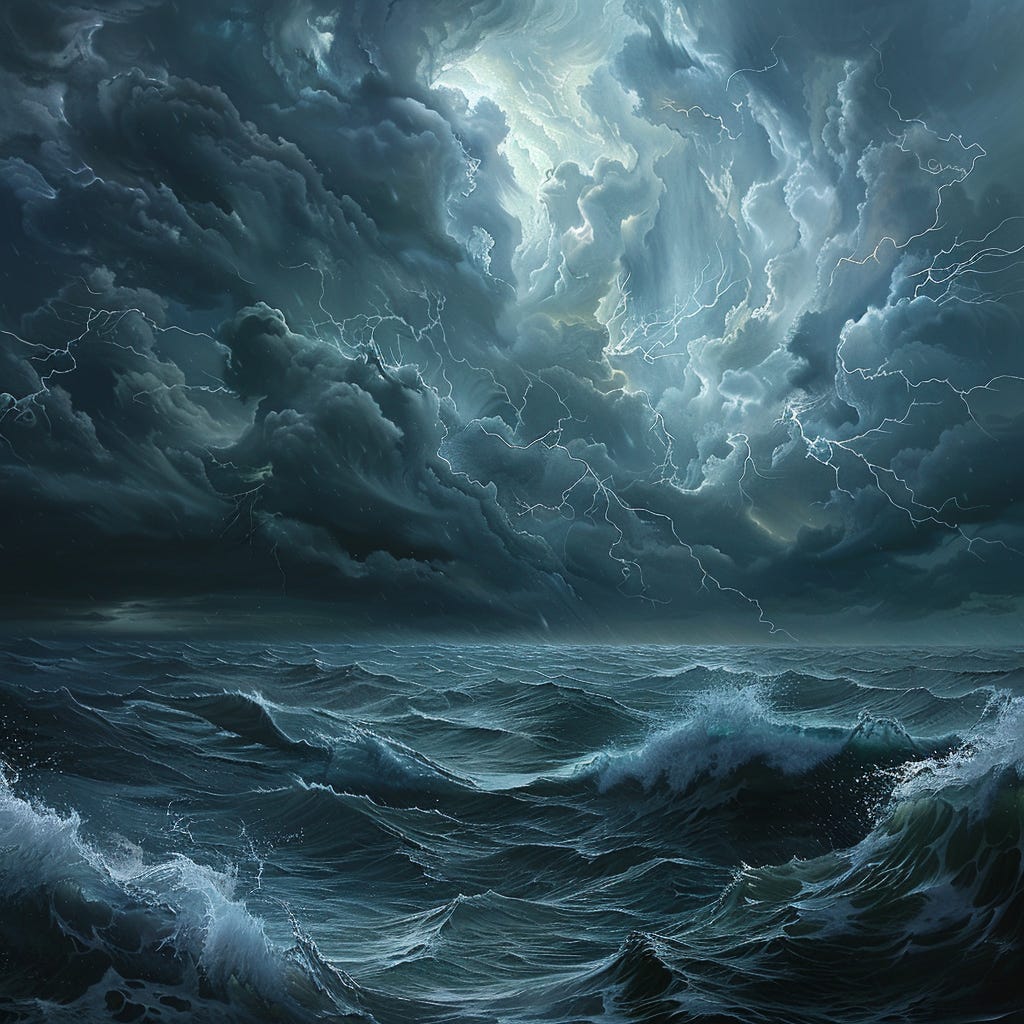
The warm Gulf Stream current meeting cold northern air masses creates conditions for sudden, violent squalls that can develop and dissipate before appearing on weather maps.
These "white squalls"—powerful storms that arrive with little warning—could have easily overwhelmed vessels, particularly in the days before satellite weather tracking.
Dr. Simon Boxall, oceanographer at the University of Southampton, explains:
"The western edge of the Bermuda Triangle coincides with the Gulf Stream, one of the most powerful currents in the world. When you get storms crossing the Gulf Stream, they can be quite violent and appear suddenly. In the days before weather satellite forecasting, these would come as a great surprise to vessels in the area."
— Simon Boxall, interview with BBC, 2009
These sudden weather patterns provide a plausible explanation for vessels disappearing without distress calls—a phenomena that might appear supernatural, were in fact natural events that struck with such speed that crews had no time to respond.
Geological Features: Methane and Magnetism
The ocean floor beneath the Triangle contains additional factors that may contribute to its hazardous reputation.
Geologists have documented deposits of methane hydrates in regions of the ocean floor, including areas within the Triangle.
These frozen methane deposits have been theorized to potentially release gas bubbles that could affect water density.
In a 2003 article in the journal Geophysical Research Letters, researchers described laboratory experiments showing that bubbles can significantly decrease water density:
"We have demonstrated that when bubbles are added to a liquid, they can dramatically change its density and therefore its buoyancy. This may explain many, but not all, of the mysterious disappearances."
— May & Monaghan, Geophysical Research Letters, 2003
While this remains a theoretical explanation for ship sinkings in the Triangle specifically, the principle has been verified in controlled settings.
The region also experiences interesting magnetic properties.
While it's inaccurate to claim it's one of only two places where magnetic north and true north align perfectly–as some do, parts of the Triangle do experience what's called magnetic variation.
The difference between true north and magnetic north does fluctuate and can affect compass readings, though experienced navigators routinely account for this variation.
Oceanic Features: The Gulf's Grip
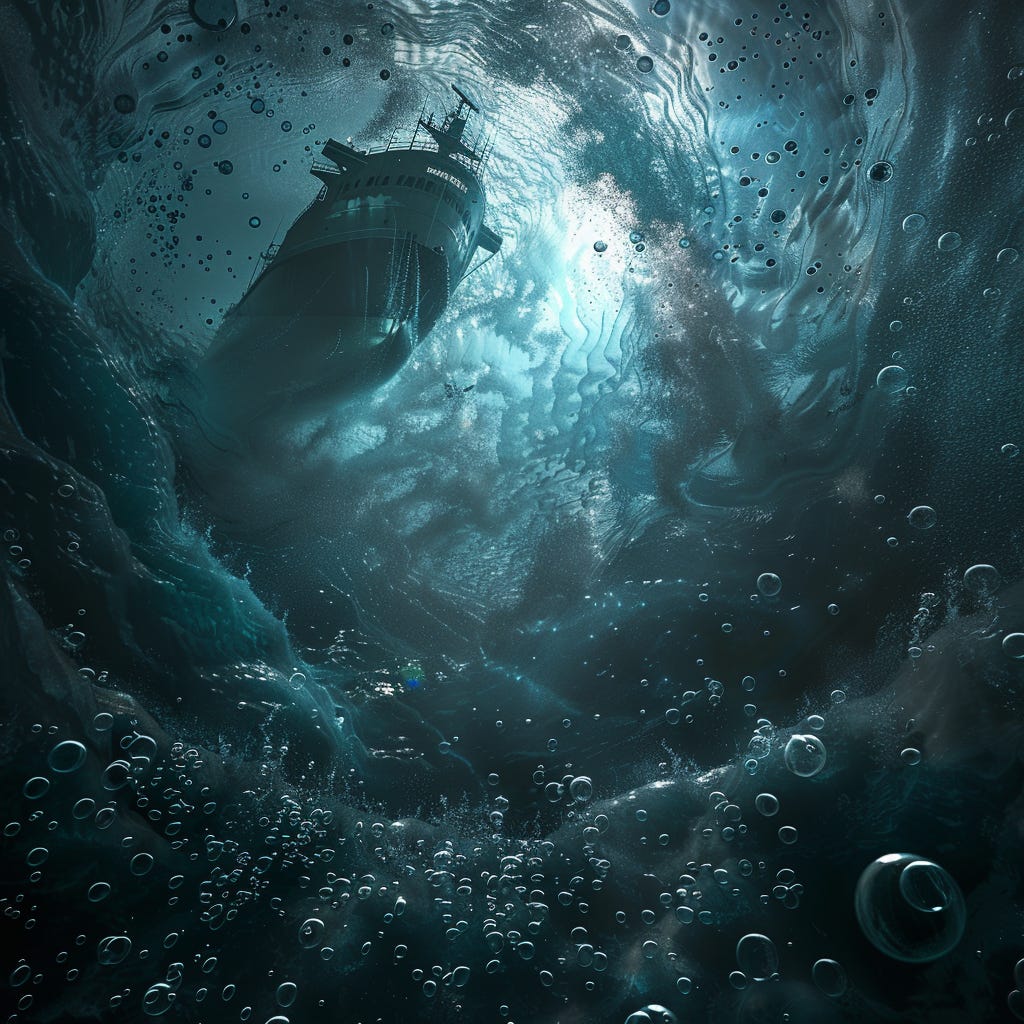
Perhaps the most straightforward explanation lies in the region's powerful currents, particularly the Gulf Stream.
This "river within the ocean" moves water north at considerable speeds—measurements by the National Oceanic and Atmospheric Administration record average speeds of 4-5 knots (4.6-5.8 mph)—sufficient to carry disabled vessels and crash debris far from their initial location before search parties arrive.
Maritime charts of the Triangle region show not just the Gulf Stream but complex systems of intersecting currents that create powerful eddies and undertows.
These oceanic features could explain both the rapid disappearance of wreckage and the navigational challenges reported by sailors in distress.
The combination of these natural factors—sudden storms, potential methane releases, magnetic variations, and powerful currents—could indeed create an environment where maritime disasters might occur more frequently and leave less evidence than in other regions.
THE HUMAN ELEMENT
Beyond physical explanations lie psychological factors that shape both how incidents occur and how we interpret them within the Triangle's boundaries.
Confirmation Bias: The Self-Reinforcing Myth
Once the Triangle achieved recognition as an anomalous zone, confirmation bias ensured its perpetuation.
Accidents occurring within its borders received disproportionate attention and were attributed to its influence, while identical incidents elsewhere were treated as ordinary maritime casualties.
Larry Kusche, whose 1975 book The Bermuda Triangle Mystery—Solved remains one of the most thorough investigations of the phenomenon, found that many of the most famous Triangle incidents were misreported in popular accounts:
"When I started researching, I was surprised to find that many of the famous incidents happened nowhere near the Bermuda Triangle; some didn't even happen at all! The more I looked, the more errors I found."
— Larry Kusche, The Bermuda Triangle Mystery—Solved, 1975
Kusche's comprehensive investigation uncovered that many disappearances attributed to the Triangle occurred during storms rather than calm conditions, left wreckage despite claims to the contrary, or happened outside the Triangle's borders entirely.
Statistical analyses by both the United States Coast Guard and Lloyd's of London have concluded that the percentage of marine losses in the Bermuda Triangle is not significantly higher than in any other similarly trafficked region of the ocean. In a 1975 statement, Lloyd's of London noted:
"We have statistics for marine insurance losses going back to the early 1800s, and the number of ships that actually founder in that area is no greater than anywhere else in the world."
— Lloyd's of London statement, cited in BBC documentary, 2009
This cognitive tendency appears throughout maritime folklore, from ancient sea serpent sightings to modern Triangle disappearances.
The psychological comfort of attributing unexplained events to a known, if mysterious, cause often proves more appealing than accepting the randomness of maritime disaster.
Navigational Psychology: Disorientation and Perception
Many Triangle incidents feature reports of disorientation, visual distortions, or electronic equipment failure.
While often attributed to supernatural causes, these experiences mirror documented psychological responses to crisis situations, particularly over water.
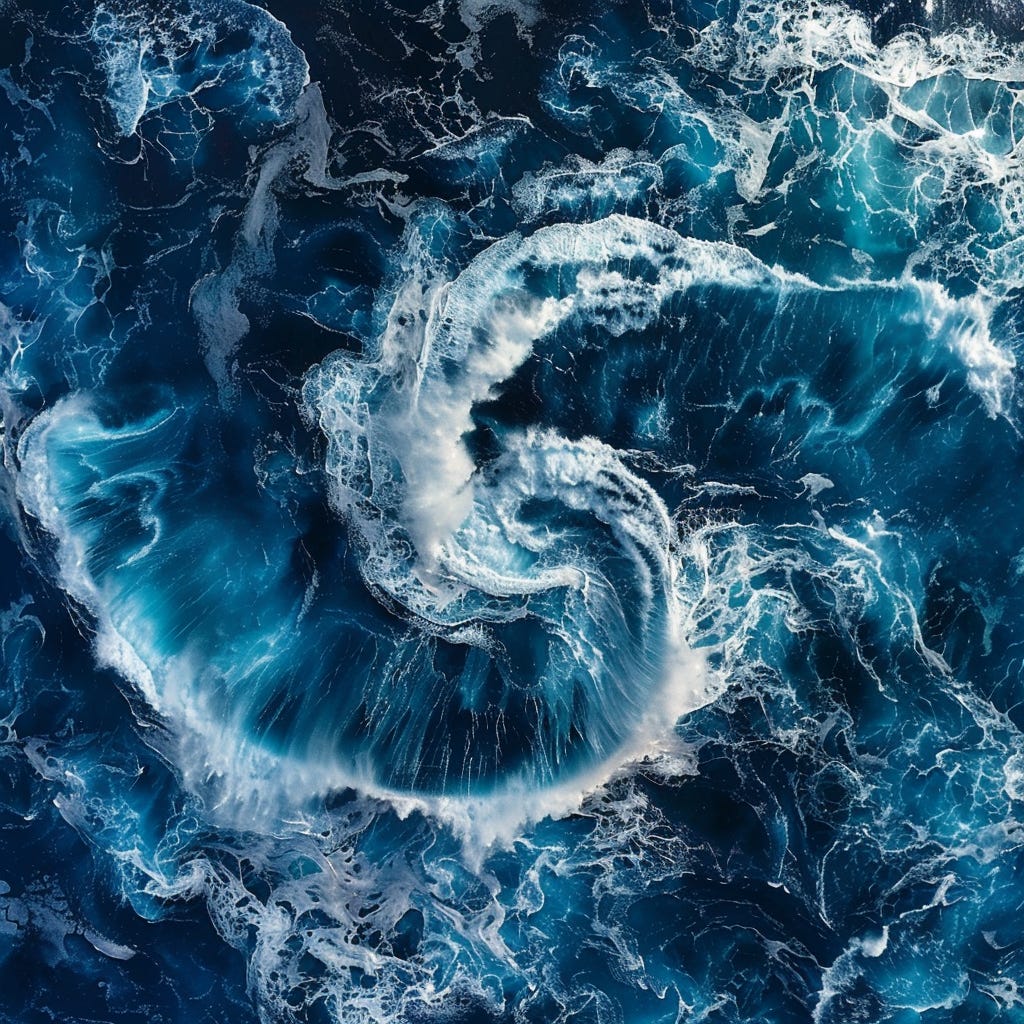
Spatial disorientation among pilots—the inability to correctly interpret aircraft position, attitude, and motion relative to the Earth's surface—occurs with alarming frequency over large bodies of water, where the horizon can become indistinct and visual reference points disappear.
The phenomenon has claimed experienced pilots across the globe, not just within the Triangle.
Dr. Rob Robson, aviation psychologist and author of Spatial Disorientation and Aviation Safety, explains:
"Flying over water creates unique perceptual challenges. Without visual reference points, pilots become dependent on instruments, but the human perceptual system often overrides instrument readings with incorrect intuitions about position and movement. This conflict between what instruments show and what feels right has caused numerous accidents."
— Rob Robson, Spatial Disorientation and Aviation Safety, 2008
These perceptual vulnerabilities create situations where skilled professionals make catastrophic errors despite their training—errors that later appear inexplicable without invoking supernatural factors.
THE MYTHOLOGICAL CURRENTS: CULTURAL LEGACY
As with other enduring maritime legends, the Bermuda Triangle transcends its factual basis to become a cultural touchstone—a modern mythology that serves purposes beyond literal belief.
Literary Echoes: From Cooper to Cussler
American literature embraced the Triangle decades before its formal naming. James Fenimore Cooper's 1849 novel The Sea Lions references treacherous waters in the region that would later be designated as the Triangle. Shakespeare's The Tempest, while not explicitly mentioning the region, is often suggested to take place in Bermuda's waters following a magical storm, drawing inspiration from accounts of the 1609 wreck of the Sea Venture on Bermuda's reefs.
Modern authors from Charles Berlitz (whose bestselling 1974 book The Bermuda Triangle popularized the mystery globally) to Clive Cussler and Douglas Preston have incorporated the Triangle into works spanning genres from purported non-fiction to adventure thrillers to supernatural horror.
Literary scholar Victoria Nelson, in her work The Secret Life of Puppets, observes how often certain geographical regions become repositories for supernatural beliefs:
"When rational thought can no longer accommodate certain persistent human needs for transcendent experience, these needs find expression through geographical anomalies—places where the supernatural seems to break through into the ordinary world."
— Victoria Nelson, The Secret Life of Puppets, 2001
In fantasy literature specifically, the Triangle often appears as a natural threshold between worlds.
The tradition of "thin places" where the boundary between ordinary and extraordinary reality becomes permeable finds perfect expression in the Triangle narrative.
Cinema and Television: Visual Mythology
Visual media has perhaps done more than any other medium to cement the Triangle in popular consciousness. Films from Steven Spielberg's Close Encounters of the Third Kind (1977), which references Flight 19 as alien abductions, to direct treatments like The Triangle (2001) and The Bermuda Triangle (1978) have established visual conventions for depicting the region's dangers—eldritch lights, instrument malfunctions, and reality distortions.
Television series including The X-Files and Supernatural featured Triangle-centered episodes that connected the region to their larger mythologies of unexplained phenomena. The 2005 miniseries The Triangle offered one of the most elaborate fictional explanations, involving time distortions and parallel universes.
Even children's programming incorporated the legend, with cartoons from Scooby-Doo to Duck Tales featuring Triangle adventures, introducing generations of viewers to the concept before they encountered historical accounts.
THE PHILOSOPHICAL WATERS: MEANING IN MYSTERY
Beyond its scientific explanations and cultural representations though, the Bermuda Triangle serves a deeper philosophical function in our relationship with the natural world—particularly the oceans that cover 71% of our planet yet remain largely unexplored.
The Unmapped Mind
In an age of satellite mapping and GPS precision, the Triangle represents a curious geographical anomaly—a place that resists definitive explanation despite existing within heavily monitored waters.
This resistance to complete understanding challenges our presumption of cartographic mastery over the natural world.
The persistence of the Triangle phenomenon raises questions about our relationship with mapping and knowing.
We have mapped the entire globe, yet the maps themselves are not the territories they represent—a distinction that becomes most apparent in regions where our explanatory frameworks seem insufficient.
Philosopher Alfred Korzybski's famous dictum "the map is not the territory" finds perfect expression in the Triangle phenomenon—a reminder that our representations of reality, however sophisticated, remain distinct from reality itself.
Our impulse to map, name, and explain sometimes exceeds our actual capacity to understand.
Quantum Uncertainties
The Triangle emerged as a cultural phenomenon alongside developments in quantum physics that challenged Newtonian certainties about the physical world.
As scientists discovered fundamental unpredictability at the quantum level—and as philosophers absorbed the implications of this uncertainty—the Triangle offered a macroscopic space where classical predictability similarly faltered.
While no serious physicist suggests quantum effects explain Triangle disappearances, the psychological parallel remains significant.
Both quantum physics and Triangle accounts describe spaces where intuitive expectations about causality and physical behavior become unreliable—where the observer's position affects the observed reality.
The Necessity of Mystery
Perhaps most profoundly, the Bermuda Triangle manifests what might be called the navigational paradox: the recognition that orientation requires both known references and unknown territories.
Navigation—whether across oceans or through life—demands both certainty and mystery to function properly.
A world entirely mapped leaves no room for discovery.
The Triangle preserves space for wonder within the bounded seas of certainty—a psychological necessity for creatures who evolved not just to follow paths but to forge them.
In this sense, the Triangle's endurance despite rational explanation reflects not human credulity but human necessity—our need for spaces where the known and unknown converge, where certainty gives way to possibility.
The mind, like the compass, requires both fixed points and open horizons to navigate effectively.
THE HORIZON: BETWEEN FACT AND LEGEND
As our exploration approaches its conclusion, we find ourselves in that same ambiguous territory where the Bermuda Triangle itself exists—a region between documented fact and enduring legend, between rational explanation and persistent mystery.
The factual record suggests that natural explanations suffice for the disappearances attributed to the Triangle.
Magnetic variations, theoretical methane releases, sudden storms, and powerful currents create conditions where maritime disasters might leave minimal evidence.
Statistical analyses find nothing extraordinary about accident rates within the Triangle's borders.
Yet the legend persists and not merely through ignorance or sensationalism, but because it serves functions beyond literal belief.
It preserves space for uncertainty in an age of presumed certainty, maps the boundaries of our cartographic confidence, and provides a geographical location for our awareness that the natural world—particularly the oceans—exceeds complete human comprehension.
The Triangle reminds us that navigation—whether across water, through life, or through knowledge—requires both fixed reference points and awareness of what lies beyond our current maps.
It challenges the notion that full understanding equals control, suggesting instead the need for humility, and the recognition of persistent mystery even in familiar waters.
Perhaps this explains why the Triangle continues to captivate us despite rational explanations.
It's not merely a geographical location but a psychological territory—a space where we confront the limitations of certainty and the necessity of wonder.
In troubled waters where compasses spin and familiar references disappear, we discover not just danger but the possibility of new orientation—new ways of understanding our relationship to the vast and largely unexplored oceans that surround our terrestrial certainties.
The Bermuda Triangle reminds us that some regions—both geographical and psychological—serve us best not by yielding complete explanation but by preserving the productive tension between knowledge and mystery, between mapping and wondering, between navigation and exploration.
In a world increasingly defined by presumed certainty, such spaces remain necessary bearings for the human journey.
DID YOU SEE THIS? (Just asking…)
To celebrate my first 50 subscribers I’ll write a bonus essay,
and YOU can choose the topic!
You can VOTE HERE, the poll will be up on the page and linked in every post until we get to 50!!!
SEA you in the COMMENTS:
Up to you now:
Share in the comment about a time when familiar territory suddenly felt foreign.
A neighborhood that looked different at night, a routine that suddenly felt strange, or a moment when the world around you shifted into something unrecognizable. What was your "cursed waters" experience?
And did it prompt something creative out of you?
-
Previous in this series: "Selkies & Seal People: Shape-shifters of the Sea" – exploring the liminal beings who navigate the threshold between human and seal forms.
Next in this series: "Ghost Lighthouses: Phantom Lights and Haunted Keepers" – examining the supernatural phenomena associated with these sentinels between land and sea.
Image Note: Unless otherwise credited, the illustrations in this post are creative interpretations developed by the author with AI assistance, designed to evoke the atmosphere of maritime legend rather than serve as historical documentation. For historical visual references, please consult the sources listed in the references section.
About the Author: Morgan A. Drake crafts dark maritime fantasy that explores the boundaries between historical seafaring traditions and the supernatural. Drawing on years of research into maritime mysteries and folklore, Morgan creates worlds where the line between natural and otherworldly perils blurs with the horizon. Subscribe to "Fathoms Deep" for twice-monthly explorations of maritime legends and fantasy craft.
References and Further Reading
Berlitz, C. (1974). The Bermuda Triangle. Doubleday.
Boxall, S. (2009). Interview with BBC for documentary "The Bermuda Triangle: Beneath the Waves."
Gaddis, V. (1964). "The Deadly Bermuda Triangle." Argosy magazine, February 1964.
Kusche, L. D. (1975). The Bermuda Triangle Mystery—Solved. Harper & Row.
May, D. A., & Monaghan, J. J. (2003). "Can a Single Bubble Sink a Ship?" American Journal of Physics, 71(9), 842-849.
Nelson, V. (2001). The Secret Life of Puppets. Harvard University Press.
Parrott, D. G. (2003). Tall Ships Down. International Marine/McGraw-Hill.
Robson, R. (2008). Spatial Disorientation and Aviation Safety. Aviation Press.
Rosenberg, H. (1974). “Exorcising the Devil’s Triangle”, published in Sealift No. 6
United States Coast Guard. (1963). Marine Casualty Report: SS Marine Sulphur Queen.
U.S. Navy Historical Center. (1975). Official statement on USS Cyclops disappearance.
Winer, R. (1974). The Devil's Triangle. Bantam Books.